Dalian Ada Ship & Marine Engineering Co., Ltd.

Dec 26,2017
Dalian Shipyard teaches you the correct understanding of electronic charts
Electronic Chart Display and Information System (ECDIS) is another great technological revolution in ship navigation after radar/ARPA, and has developed into a new type of ship navigation system and decision support system. It can not only continuously give the ship's position, but also provide various information related to navigation, effectively preventing various dangers. At present, there are more than 200,000 ships in the world equipped with electronic charts. With the gradual improvement of national official electronic charts (ENC), the emergence of standard ECDIS and the recognition of IMO, ECDIS will completely replace paper charts in the next 10 years and become the 21st century navigation information integration
Dec 26,2017
Dalian Shipyard: Other ship fittings and equipment
Dalian Shipyard explains other shipboard equipment and devices, as well as monthly maintenance issues. Ship outfitting includes interior structures (inner walls, ceilings, floors, etc.), furniture and living facilities (cooking, sanitation, etc.), painting and varnishing, doors and windows, ladders and railings, masts, hatch covers, etc. Other shipboard equipment and devices, in addition to the propulsion system, include anchor and mooring equipment, rudder and steering gear, life-saving equipment, fire-fighting equipment, internal and external communication equipment, lighting equipment, signaling equipment, navigation equipment, cargo handling equipment, ventilation, air conditioning and refrigeration equipment, seawater and fresh water systems, and ballast.
Dec 26,2017
Dalian Ada Ship reminds you: Winter is coming, take good care of your boat
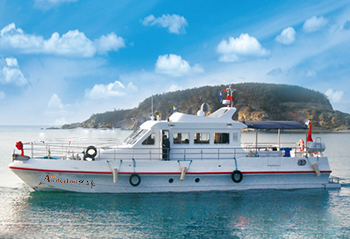
Check antifreeze. Antifreeze has excellent properties such as antifreeze in winter, anti-boiling in summer, and all-year-round anti-scaling and anti-corrosion. Like a car, the use and maintenance of a yacht in winter starts with checking the antifreeze. When the temperature approaches 0℃, pour the antifreeze mixture into the cooling pipe, and the water-containing device can effectively prevent freezing. It is worth noting that the cooling circuit needs to be cleaned before injecting antifreeze. However, when the ambient temperature drops below 0℃, the water in the pipe may still freeze and cause the pipe to rupture. Therefore, frequently check all water-containing systems and equipment, including seawater systems and freshwater systems, such as the engine cooling system and generator cooling system.
Dec 26,2017
Common Problems and Solutions for Fiberglass Boats in Dalian
Common fiberglass problems include: cracking of the gel coat at structural joints, water leakage/seepage at joints/openings, blistering or black spots on the surface of the fiberglass hull deck, blistering or cracking of the non-slip plates on the deck, seepage in the hull bottom, scratches and cracks from collisions during use, and discoloration or color differences in the gel coat surface of the fiberglass boat. These problems may be caused by manufacturing negligence or improper use. The causes and solutions for these problems are described below: 1. Discoloration and blistering of the surface gel coat

Dec 26,2017
Dalian Shipyard: Ship Formation Mooring Operations
The ship formation should comply with the relevant formation principles and determine the formation order according to the arrival time of the barges. The tugboat should slowly approach the head barge from the outboard side of the towed vessel, connect the head towline, stop in time when the stern reaches the head barge, reverse if necessary, and after the vessel is stable, connect the towline. Avoid blindly starting the engine to connect the towline. After connecting the towline, notify the barge fleet to release other mooring lines on the shore. After all mooring lines are released, the tugboat can slowly move forward only after the barge gives the signal to move forward. Gradually use a small rudder angle to make the ship yaw outward, and direct the barge's rudder. Only when the fleet does not obstruct passing vessels and surrounding moored vessels can the tugboat move forward at full speed. When starting after anchoring the formation, before connecting the towline, the anchoring preparation should be completed. The tugboat should approach the head barge from the windward side, take over the towline, connect the long towline, and move forward slowly. When the long towline just rises above the water surface, stop, and after the long towline is under tension, move forward slowly again. Only after the barge completes the anchoring operation can the tugboat tow and start sailing. When releasing or taking in the long towline during navigation, the tugboat should first reduce speed to reduce the surge of the fleet, and direct the steering of each barge. Only when the fleet is stable and straight when turning can the long towline be released or taken in. When releasing or taking in the long towline, pay attention to personal safety. During formation, towing, and releasing or taking in the towline, pay close attention to the dynamics of passing vessels and the surrounding environment. Only when there is no obstruction to other vessels and the safety of the fleet can actions be taken, and signals should be sounded according to regulations. The ship formation should generally be conducted by the chief mate or captain. It is strictly prohibited to use one towline at both ends, and it is prohibited to temporarily draw towlines from the cabin or anchor. When connecting the towline midway, reduce speed and wait for the fleet to stabilize before proceeding. It is strictly prohibited to connect the towline quickly.

Dec 26,2017
Chemical corrosion and protection of ships in seawater
Chemical Corrosion and Protection of Ships in Seawater Due to the long-term exposure of ships to marine environments, the hull is extremely susceptible to corrosion in seawater. The main types of corrosion include electrochemical corrosion, mechanical corrosion, biological corrosion, and chemical corrosion, with electrochemical corrosion being the most significant, involving the generation of microcurrents during the corrosion process. Electrochemical corrosion mainly includes corrosion in seawater, atmospheric corrosion, galvanic corrosion, micro-electrode corrosion, and corrosion under coatings. The mechanism of electrochemical corrosion is the result of a battery effect. The mechanisms of microbial corrosion mainly include cathodic depolarization theory, local battery mechanism, metabolic product corrosion mechanism, acid corrosion mechanism, and anodic fixation mechanism.